
Pastors on the Puritans #1
This is the beginning of a new series we’re doing called Pastors on the Puritans where we interview pastors on their perspective of the Puritan writings and how they and their ministries have been influenced by the Puritans. In this first edition, we interview Pastor Spencer Revely from Makakilo Bible Church in Hawaii. We trust this series will be edifying for you.
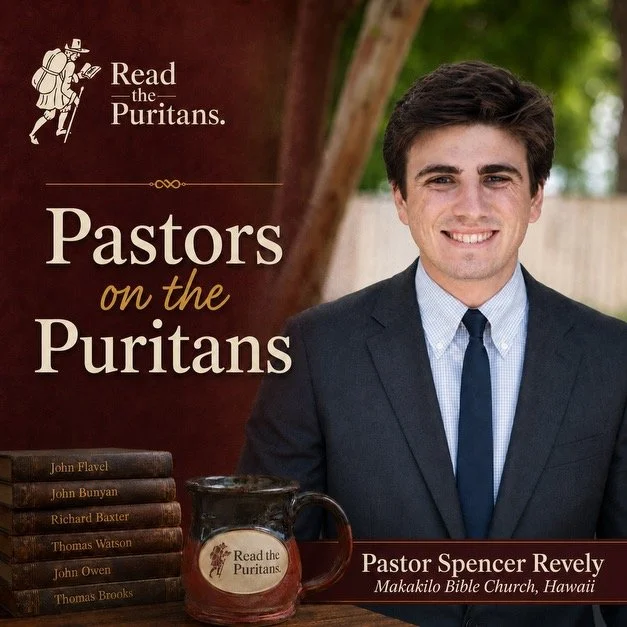
A Conversation with Pastor Spencer
Give a brief bio of yourself and your ministry (past and current) that you’re good with being public.
I currently serve as the Teaching Pastor at Makakilo Bible Church, Hawaii. I was born in Orange County, California and graduated from The Master’s University (2017) and Seminary (2023) with my bachelor’s and MDiv. I first came to Makakilo Bible Church as an intern in the summer of 2016 and returned here after completing seminary in 2023.
How did you first discover the writings of the Puritans?
I was 14 when I was baptized. As a celebratory gift, my sister gave me a book by C.H. Spurgeon. From that, I became a big fan of Spurgeon. Since Spurgeon loved the puritans—he said he read John Bunyan’s Pilgrim’s Progress a hundred times—I started reading them as well.
What was the first Puritan book you read?
Upon Spurgeon’s recommendation, Pilgrim’s Progress.
What is your favorite Puritan book? Why?
The first cut is the deepest. Pilgrim’s Progress is still my favorite. There is so much that could be said about it. It is amazing how Bunyan’s blatant allegories are so moving and encouraging. It is a very pastoral book.
Who is the Puritan who has impacted you the most? Why?
Once again, it would be John Bunyan. Pilgrim’s Progress and Grace Abounding to the Chief of Sinners were both significant encouragements, particularly during my first years as a Christian.
Do you think Christians should read the Puritans? Why?
Absolutely! There is so much excellent theology written among the Reformed in Europe in the 1600s. Much of that is only accessible through translation. With the Puritans, we have sound and deep theology already in English. As such, they have had a huge impact on Reformed theology in the English-speaking world. To understand developments in Reformed theology in England and America, it is essential to be familiar with the contributions of the Puritans.
What is the latest Puritan book you’ve read?
It was a book about a Puritan rather than by a Puritan. I recently read Carl Trueman’s The Claims of Truth: John Owen’s Trinitarian Theology, which helped place Owen’s theology in the development of doctrine, particularly in contrast to the Puritan Richard Baxter.
Have the Puritans had a positive influence on your own sanctification? What about your ministry?
They have. I have talked enough about Pilgrim’s Progress. One passage I constantly refer to when counseling others comes from John Owen’s The Mortification of Sin. While a bit lengthy, I think it’s worth copying it here to let Owen speak for himself:
“This kind of endeavor for mortification proceeds from a corrupt principle, ground, and foundation; so that it will never proceed to a good issue. The true and acceptable principles of mortification shall be afterward insisted on. Hatred of sin as sin, not only as galling or disquieting, a sense of the love of Christ in the cross, lies at the bottom of all true spiritual mortification. Now, it is certain that that which I speak of proceeds from self-love. You set yourself with all diligence and earnestness to mortify such a lust or sin; what is the reason of it? It disquiets you, it has taken away your peace, it fills your heart with sorrow and trouble and fear; you have no rest because of it. Yea, but friend, you have neglected prayer or reading; you have been vain and loose in your conversation in other things, that have not been of the same nature with that lust wherewith you are perplexed. These are no less sins and evils than those under which you groan. Jesus Christ bled for them also. Why do you not set yourself against them also? If you hate sin as sin, every evil way, you would be no less watchful against everything that grieves and disquiets the Spirit of God, than against that which grieves and disquiets your own soul. It is evident that you contend against sin merely because of your own trouble by it. Would your conscience be quiet under it, you would let it alone. Did it not disquiet you, it should not be disquieted by you. Now, can you think that God will set in with such hypocritical endeavors—that ever his Spirit will bear witness to the treachery and falsehood of your spirit? Do you think he will ease you of that which perplexes you, that you may be at liberty to that which no less grieves him? No. God says, “Here is one, if he could be rid of this lust I should never hear of him more; let him wrestle with this, or he is lost.” Let not any man think to do his own work that will not do God’s. God’s work consists in universal obedience; to be freed of the present perplexity is their own only. Hence is that of the apostle: “Cleanse yourselves from all pollution of the flesh and spirit, perfecting holiness in the fear of God” (2 Cor. 7:1). If we will do anything, we must do all things. So, then, it is not only an intense opposition to this or that peculiar lust, but a universal humble frame and temper of heart, with watchfulness over every evil and for the performance of every duty, that is accepted.”
What do you think sets the Puritans apart from what we see on Christian bookshelves today?
Well, I am cautious about setting the Puritans as a whole on a pedestal. Amongst those who would name themselves in their number, there were certainly those who advocated theological error (e.g. Baxter) and committed wicked acts in the Civil War (e.g. regicide and the murder of civilians).
Yet, time has a way of consigning garbage literature to the dustbin of history. Therefore, the works of the Puritans that are readily available today are usually of exceptional theological quality. While Pilgrim’s Progress is unique in the history of Christian literature, I would hope that 400 years from now, our era will have produced many great theological works as well. But for now, the markets are flooded with books that are not marked by theological truth and clarity, but by vanity and niceties that will move inventory.
If a person in your church asked you what the first Puritan book they read should be, what would you recommend and why?
Here at MBC, we keep a large inventory of Pilgrim’s Progress in both the original and modern English to distribute to new members here at church. It is a book for all ages and all times.
The Lord continues to cross our paths with faithful believers that have been heavily influenced by the Puritans. As we do, we intend to bring you their perspectives. If you are a pastor, or know one that would be willing to provide their insight, please let us know. In the meantime, learn more about Pastor Spencer and his ministry at Makakilo Bible Church below and join us in praying for the body there.