Commentary
It’s been said that what comes into your mind when you think about God is the most important thing about you. I’d argue that what comes into your mind when you hear the word “meditation” is one of the most important things about your ability to walk with God.
Yet sadly the Biblical doctrine of meditation is either completely missing from the modern church or wholly misunderstood. When was the last time a brother or sister in Christ asked you about how your meditation has been? More than likely, you are regularly exhorted to read God’s Word and maintain an active prayer life (as you should be). But meanwhile, the word meditation seems to only come up in the context of yoga class or latest YouTube video on grounding exercises.
However, the Puritans considered meditation to be the “chief among duties”, regularly referring to it in their sermons and writings. Thomas Brooks asserts “it is not he that reads most, but he that meditates most, that will prove the choicest, sweetest, wisest, and strongest Christian.”
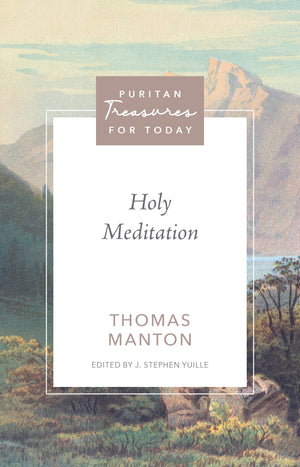
In Holy Meditation, an abridged excerpt taken from Sermons on Genesis, Thomas Manton aims to press home this duty of meditation and its primacy in the Christian walk. He defines meditation as:
“The duty or exercise of religion whereby the mind is applied to the serious and solemn contemplation of spiritual things for practical uses and purposes.”
Notice this definition immediately goes against the Eastern practice of meditation which stresses the emptying of the mind. Manton argues that instead of letting go of our thoughts, Biblical meditation does the opposite by reorienting our minds on higher objects of delight, knowing that thoughts themselves are the “noblest offspring of the soul.” Manton calls it a “pure and rational converse with God … the flower and height of consecrated reason” without which all others graces like faith, hope, and love wither away.
Manton describes how meditation is the “middle duty” between the “holy discipline trinity” of reading God’s Word and prayer: “The Word feeds meditation and meditation feeds prayer.” This is critical, because Manton rightfully likens our minds to hole-ridden bags, able to retain what we hear only for a limited time before all that “living water” empties out (James 1:23-24). Ever wake up on a Monday having completely forgotten what you heard preached on Sunday? Ashamedly I find myself there too often. Meditation takes this transient knowledge and presses it onto the affections by deliberate thoughts.
In God’s Battle Plan for the Mind, David Saxton likens meditation to the digestive system which converts food into energy. He describes reading the Word of God without meditation as a man who studies the food in the buffet line without ever actually taking a bite of it; all the while expecting it to provide nourishment for his body. Regardless of how informed that man may be about the properties and benefits of said food, such knowledge would do him absolutely nothing. That’s exactly what we do when we hear or take in the Word of God without meditating on it.
Manton writes that prayer is one of the direct results of this “middle duty”; it is literally “the vent of the thoughts.” Perhaps why we struggle so much with our prayer life is because we are not meditating on the Word of God. In fact, prayer without meditation can be dangerous, as our entropy-prone emotions and dreams can usurp the revealed will of God found in His Word. The famous German pastor and anti-Nazi dissident Dietrich Bonhoeffer put it perfectly in his little book on prayer:
“It is a dangerous error, surely widespread among Christians, to think that the heart can pray by itself … the child learns to speak because his father speaks to him. He learns the speech of his father. So, we learn to speak to God because God has spoken to us and speaks to us.”
Meditation is like “learning to speak” the language of our Father so that we can effectively communicate.
Manton emphasizes that the ultimate result of meditation is heart work, not head work: “The end of such meditation is not to fill the head with notions, but to improve the heart.” The outcome is a change in our affections, not the improvement in the size of our theological craniums. Listen to how the Psalmist summarizes meditation:
“But his delight is in the law of the Lord, and in His law he meditates day and night.” (Psalm 1:2)
“Meditate within your heart on your bed, and be still.” (Psalm 4:4)
“Give ear to my words, O Lord, consider my meditation.” (Psalm 5:1)
“My heart is overflowing with a good theme … My tongue is the pen of a ready writer.” (Psalm 45:1)
“I will meditate on Your precepts, and contemplate Your ways.” (Psalm 119:15)
“Oh, how I love Your law! It is my meditation all the day.” (Psalm 119:97)
The truth is, we’re always meditating on something. Ask any sports fan about the team they religiously follow and be prepared to hear the result of hours of meditation. Ultimately, the question is not whether we’re meditating, but what we’re meditating on. The problem here is that while meditation on the creation comes natural to our fallen natures, not so much the supernatural. How can we discipline ourselves toward Biblical meditation? How do we foster this means of grace?
Well, buy the book if you want to hear Manton clearly and concisely describes the how or method of meditation. But he doesn’t stop there. As a practical shepherd and tactician, he then devotes nearly the entirety of the second half of the book focusing on what we are to meditate on. These chapters read like short mini sermons as he beautifully describes various objects of our meditation; the list says it all: The Chief End of Man, Enjoying God, Eternal Delight, Sinfulness of Sin, Nature and Effects of Sin, God’s Wisdom in the Gospel, God’s Glory and Comfort in the Gospel, and the Mystery, Grounds, and Acts Providence. After reading through these short chapters, I guarantee you will be encouraged while walking away with some beautiful objects of meditation.
So, how has your meditation been?
More importantly, what have you been meditating on?
The answers to these questions will provide a good window into your soul.
Structure of the Book
The book is divided into 34 chapters loosely following 7 major themes:
Introduction
The Doctrine of Meditation (chapters 2-4)
The Advantages of Meditation (chapters (5-7)
Helpful Guidelines (chaptesr 8-9)
The Barriers to Meditation (chapters 10-14)
The Method of Meditation (chapters 15-18)
The Objects of Meditation (chapters 19-34)
Conclusion
Five Key Quotes
“The fruit of study is to store up truth, but the fruit of meditation is to practice it … the end of such meditation is not to fill the head with notions, but to improve the heart.”
“Meditation is the middle duty between reading or hearing God’s Word and praying. The Word feeds meditation and meditation feeds prayer.”
“Joy and delight are fed by meditation, for it turns God’s promises into food.”
“In meditation our aim is to promote the good of our souls. When we speak with others, we aim at their good, but the purpose of meditation is our good."
“Meditation is enforcing a truth on the soul by discourse or pressing arguments.”
Recommended Complementary Reading
God’s Battle Plan for the Mind: the Puritan Practice of Biblical Meditation by David Saxton
Solitude Improved by Divine Meditation by Nathanael Ranew
A Treatise of Divine Meditation by John Ball
Also check out our RTP reading list for Biblical Mediation
Where to Buy the Book
If you purchase the book through the following link, RTP gets a small percentage back which we will use to fund our operations. It’s costs nothing extra to you and you’ll be helping us connect the Puritans with Christ’s church worldwide.